

1. The Fundamental Difference: Creation vs Execution
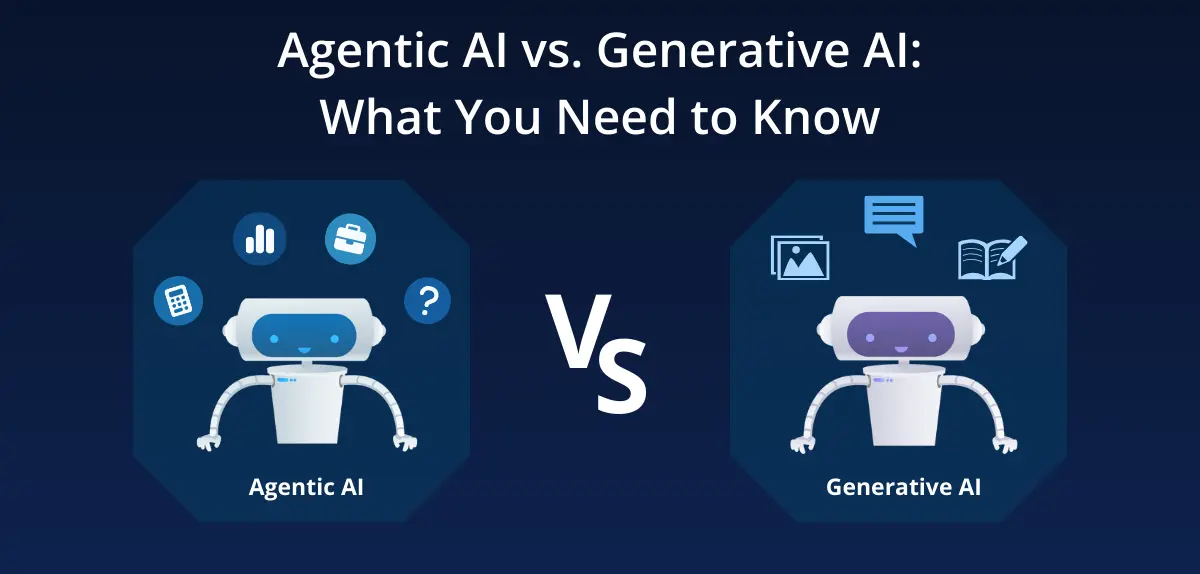
To choose the right career path, you must first understand the fundamental difference in the ultimate goal of these two fields. Generative AI is all about 'Creation.' It focuses on models that take an input (prompt) and generate novel text, images, audio, or code as an output. It is inherently passive; it waits for a human to ask it a question.
Agentic AI, on the other hand, is about 'Execution.' It focuses on building autonomous systems that take a high-level goal and independently execute a sequence of actions to achieve it. Agentic systems do not just generate text; they make decisions, use tools, interact with APIs, and correct their own mistakes without human intervention.
Think of it this way: Generative AI is the brilliant consultant who gives you an amazing strategy document. Agentic AI is the tireless employee who reads that document, opens up the company laptop, and actually implements the strategy.
- Generative AI focuses on content and code creation (Passive).
- Agentic AI focuses on goal-directed execution (Active).
- GenAI produces output; Agentic AI takes action.
- Agentic AI uses GenAI as its 'brain' but adds memory and tools.
2. The Generative AI Career Path
A career in Generative AI involves working intimately with Large Language Models (LLMs) and diffusion models. As a GenAI engineer, your primary goal is to optimize the interaction between users and the underlying foundational models.
Your day-to-day work will heavily involve Prompt Engineering, Fine-Tuning, and RAG (Retrieval-Augmented Generation). You will spend your time building systems that can accurately query massive corporate documents and return highly synthesized answers without hallucinating. You will work extensively with Vector Databases (like Pinecone, Milvus, or Weaviate) to store and retrieve semantic embeddings.
This path is ideal for developers who love data science, NLP (Natural Language Processing), and building incredibly smart 'chatbots' or content generation pipelines that augment human creativity.
- Core Focus: RAG pipelines, Prompt Engineering, Fine-Tuning.
- Tech Stack: Python, LangChain, Hugging Face, Vector Databases.
- Key Challenge: Reducing hallucinations and improving data retrieval.
- Ideal for: Developers who enjoy NLP, data structures, and content synthesis.
3. The Agentic AI Career Path
The Agentic AI path is fundamentally different; it is much closer to traditional Software Engineering and Systems Architecture. An Agentic AI Engineer builds autonomous 'agents' that perform complex workflows. You aren't just trying to get the LLM to output a good sentence; you are trying to get it to write a Python script, execute it, read the error logs, and fix its own code.
Your day-to-day will involve building 'Tools'—the interfaces that allow the LLM to interact with the outside world (like bash terminals, GitHub APIs, or SQL databases). You will design complex architectures where multiple agents (a Planner, a Coder, and a Reviewer) communicate with each other in a 'swarm.'
This path is ideal for senior software engineers, system architects, and DevOps professionals who want to automate their workflows. It requires a deep understanding of software design patterns, because debugging an autonomous agent that hallucinates an infinite loop is a complex architectural challenge.
- Core Focus: Tool calling, Multi-Agent Swarms, Autonomous Workflows.
- Tech Stack: CrewAI, AutoGen, LangGraph, standard APIs and CI/CD.
- Key Challenge: Preventing 'excessive agency' and managing infinite loops.
- Ideal for: System Architects, Backend Developers, and DevOps Engineers.
4. Comparing the Tech Stacks
While both paths rely heavily on Python, the libraries and frameworks you must master diverge significantly.
In Generative AI, you must deeply understand tokenization, embedding models, chunking strategies, and vector distance metrics (Cosine similarity). You will live inside Jupyter Notebooks experimenting with different RAG architectures.
In Agentic AI, you are building state machines. You will use frameworks like LangGraph to map out the cyclical flow of an agent's reasoning. You will spend time writing robust API wrappers (Tools) that the LLM can safely invoke. Security is a massive part of the Agentic stack, as you must sandbox the environments where these agents execute code to prevent them from accidentally destroying production databases.
- GenAI Stack: Vector DBs (Pinecone), Embedding Models, LlamaIndex.
- Agentic Stack: State Machines (LangGraph), Tool APIs, Docker Sandboxing.
- GenAI focuses on data pipelines; Agentic focuses on execution pipelines.
- Security in Agentic AI requires strict Sandboxing (Zero Trust).
5. Salary Expectations and Market Demand in 2026
Currently, both fields command premium salaries, often sitting in the top 5% of tech compensation brackets. However, the market demand is shifting.
Generative AI has become slightly commoditized. Building a basic RAG pipeline over a PDF is no longer a million-dollar skill; tools have made it highly accessible. The true value in GenAI now lies in extreme scale and reducing latency.
Agentic AI, however, is the new frontier. Companies are desperate for engineers who can build autonomous systems that actually 'do the work.' The ability to build a multi-agent system that can autonomously resolve Jira tickets or perform automated vulnerability scanning commands an incredible premium. Agentic AI Engineers are currently seeing higher starting salaries because the role requires a rare combination of AI knowledge and elite traditional software engineering.
- Basic GenAI (simple RAG) is becoming commoditized.
- Agentic AI is the current high-demand frontier.
- Companies pay a premium for automation of complex workflows.
- Agentic roles require deep traditional Software Architecture skills.
6. Making Your Choice
So, which path should you choose? If you are fascinated by how language models 'think', love working with unstructured data, and want to build the smartest virtual assistants in the world, the Generative AI path is for you.
But if you view LLMs merely as 'reasoning engines'—tools to be plugged into a larger system—and your goal is to automate entire software development lifecycles, then Agentic AI is your calling. Agentic AI is for the builders, the architects, and the hackers who want to create digital employees.
Whichever path you choose, the era of the 'traditional' developer writing boilerplate code is ending. Upskilling in either of these advanced domains is the only way to guarantee a lucrative and secure IT career in the coming decade.
- Choose GenAI if you love Data Science, NLP, and unstructured data.
- Choose Agentic AI if you love System Architecture and workflow automation.
- Both paths offer incredible job security compared to standard web development.
- Continuous upskilling is the key to thriving in 2026.
Explore Local IT Training Programs
Top-rated job-oriented training & internships in Coimbatore & Chennai