

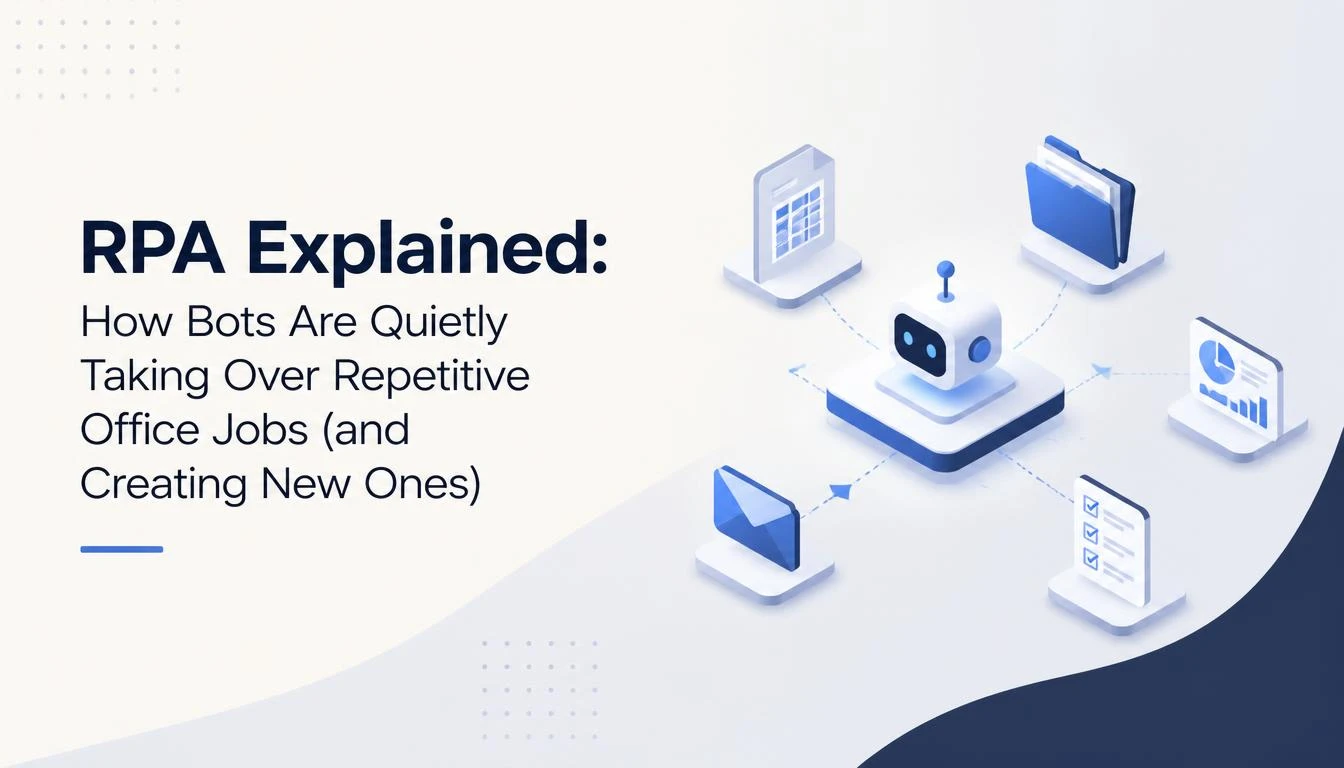
1. What is RPA? Understanding the Digital Workforce
At its core, Robotic Process Automation (RPA) is a software technology that enables anyone to configure computer software, or a 'bot,' to emulate human actions interacting with digital systems to execute a business process.
Think about standard office operations: an employee opens an email, downloads an Excel attachment, copies invoice numbers into an ERP system like SAP, verifies tax amounts against a government portal, and generates a confirmation PDF.
Every single one of these steps is rule-based, deterministic, and highly repetitive. RPA bots log into applications, move files, copy-paste data, read structured forms, fill out web fields, and trigger automated emails—completing in seconds what took humans hours, with 100% accuracy.
- Rule-Based Execution: Bots execute deterministic if-then-else workflows with zero fatigue.
- Non-Invasive Integration: RPA sits on top of existing IT systems without requiring costly database overhauls.
- 24/7 Productivity: Bots execute high-volume batch operations overnight, eliminating operational backlogs.
2. From Traditional RPA to 'Agentic RPA' in 2026
The landscape of enterprise automation has evolved dramatically over the last two years.
Traditional RPA was strictly deterministic. If an invoice layout shifted by 5 pixels or an unexpected popup appeared, the bot would crash and throw an exception. It acted purely as the digital 'hands'.
In 2026, the industry has embraced Agentic RPA. By combining RPA with Large Language Models (LLMs) and Computer Vision, bots now possess both 'hands' and a 'brain'.
Agentic bots can read messy, unstructured scanned receipts, extract intent from angry customer emails, make probabilistic decisions, and autonomously self-heal broken UI selectors when websites update their layout.
- Traditional RPA (Digital Hands): Executes rigid, structured, rule-based keystrokes and clicks.
- Agentic RPA (Brain + Hands): Leverages generative AI to reason through unstructured data and exceptions.
- Self-Healing Workflows: AI automatically identifies and adapts to UI changes without breaking pipelines.
3. High-Impact Industry Use Cases: Banking, Healthcare, Logistics & HR
RPA has become the operational backbone of multinational corporations operating in Tamil Nadu tech corridors.
Banking & FinTech (Chennai BFSI Sector): Automated KYC verification, anti-money laundering (AML) transaction monitoring, credit card dispute handling, and automated loan underwriting.
Healthcare & Insurance: Claims processing, patient appointment scheduling, insurance eligibility verification, and medical records migration across legacy databases.
Supply Chain & Logistics: Real-time shipment tracking, automated purchase order creation, inventory discrepancy reconciliation, and vendor invoice settlement.
Human Resources: Employee onboarding account creation, background verification checks, payroll calculation, and automated attendance consolidation.
- BFSI: 80% reduction in customer onboarding time and instant fraud pattern detection.
- Supply Chain: Automated purchase orders and real-time inventory level syncing across ERPs.
- HR & Operations: Zero-touch employee onboarding and automated payroll compliance.
4. Industry-Standard Tools: UiPath vs. Microsoft Power Automate
Two platforms dominate the enterprise automation market in 2026.
UiPath: The undisputed enterprise heavyweight. UiPath offers a complete automation suite including Studio (visual workflow builder), Orchestrator (centralized bot deployment and monitoring), Autopilot AI, and Process Mining. It is the platform of choice for large banking, telecom, and healthcare MNCs.
Microsoft Power Automate (Desktop & Cloud): The powerhouse of the Microsoft 365 ecosystem. With seamless native integration into Excel, Outlook, Teams, SharePoint, and Azure, Power Automate has democratized automation for thousands of mid-market and enterprise businesses looking for cost-effective automation.
- UiPath: Best for complex, high-volume enterprise automation, Citrix/virtual desktop environments, and advanced OCR.
- Microsoft Power Automate: Best for M365-centric organizations, desktop task automation, and rapid citizen development.
- Both platforms support custom scripting in C#, Python, VB.NET, and JavaScript.
5. Job Market Reality: Why Automation Creates High-Paying Careers
While automation replaces repetitive manual data-entry jobs, it has created a massive shortage of qualified automation engineering professionals.
In Chennai and Coimbatore, IT service giants (TCS, Infosys, Cognizant, Wipro) and global in-house centers (GICs) are aggressively hiring RPA Developers, Automation Analysts, and RPA Solution Architects.
Starting salaries for junior RPA Developers range from ₹4.5 LPA to ₹8 LPA, while experienced RPA Architects with 4–6 years of experience command ₹15 LPA to ₹25+ LPA.
Because RPA requires understanding business logic alongside programming, it offers one of the fastest career progression tracks to Solution Architecture and IT Consulting.
- RPA Developer: Designing, coding, and debugging software bots in UiPath and Power Automate.
- Process Automation Analyst: Mapping business workflows, identifying automation ROI, and writing Process Design Documents (PDD).
- RPA Solution Architect: Designing scalable enterprise infrastructure, security governance, and multi-bot orchestration.
6. Your Step-by-Step Roadmap to Becoming an RPA Engineer
To become a certified, job-ready RPA Engineer in 2026, follow this structured learning roadmap:
Step 1: Master programming fundamentals (variables, loops, conditional logic, error handling, string manipulation, and Regular Expressions/Regex in C# or Python).
Step 2: Learn data handling (Excel manipulation, CSV parsing, and SQL database queries).
Step 3: Master a leading RPA platform (UiPath Studio or Microsoft Power Automate Desktop), building automated scrapers, form-fillers, and email triggers.
Step 4: Master Advanced Exceptions & Architecture (ReFramework in UiPath, Orchestrator queue management, and logging).
Step 5: Integrate AI capabilities (Optical Character Recognition, Document Understanding, and LLM API connectors).
At Beetalogic in Coimbatore and Chennai, our Intelligent Automation & RPA training program takes you through real enterprise use cases with 100% placement assistance. Contact us today to launch your automation career.
- Structured Training: From foundational programming logic to enterprise ReFramework architecture.
- Live Business Scenarios: Automate real invoice processing, banking portals, and SAP environments.
- 100% Placement Support: Resume optimization, certification prep, and direct corporate interview drives.
Explore Local IT Training Programs
Top-rated job-oriented training & internships in Coimbatore & Chennai